

The product
Built for the last millimetre
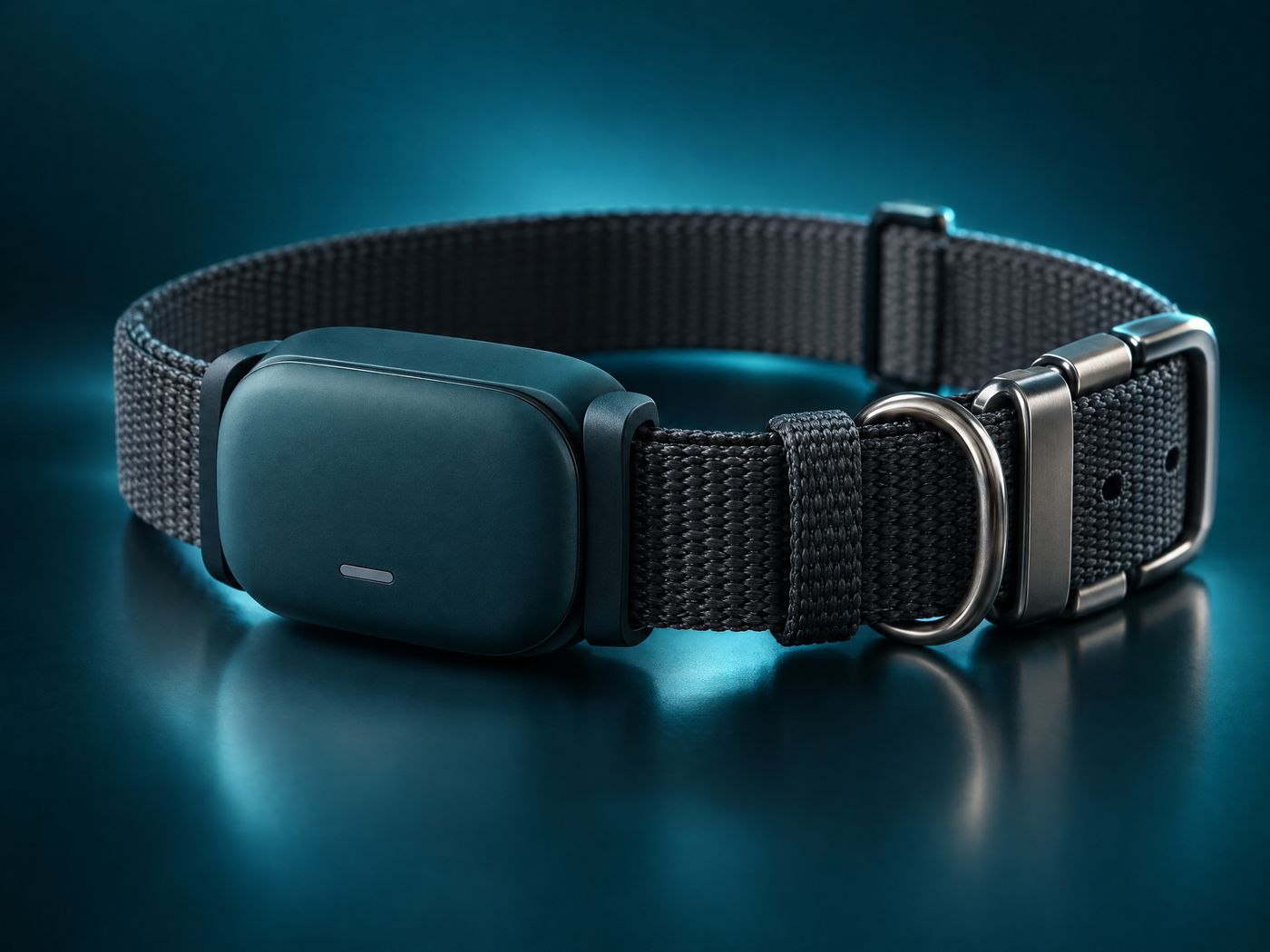
A tracker lives or dies on details that never appear on a spec sheet: antenna performance inside the closed housing and on the actual strap, real battery distribution when the signal is weak, closure integrity after months of wear, and clip retention across animal sizes.
Manufacturing risk in this category is concentrated in sealing, radio and fit. Each of those has an acceptance test on production parts, and the result is written against the serial before the unit is released.
- Location, movement and rest patterns delivered through the companion app
- Zone and boundary alerts configured by the owner, evaluated on the device or in the backend
- Charging accessory and cell selected against a published safety standard
- Serviceable strap and clip assembly rather than a sealed disposable module
Hardware architecture
Six subsystems in one wearable housing
| Cellular | LTE-M modem with India band set; SIM/eSIM provisioning per operator profile |
|---|---|
| Positioning | GNSS receiver with assisted fix for first-lock behaviour indoors and in dense housing |
| Short-range | Optional Bluetooth for near-field setup; Wi-Fi scan option for assisted positioning |
| Antenna | Detuned-compensated antenna design verified in the closed housing and on the strap |
| Battery | Portable sealed lithium cell to IS 16046 (Part 2):2018 scope, with charger accessory review |
| Housing | Moulded shell with gasket closure, torque-controlled assembly, ingress-graded |
| Wear system | Woven strap, buckle and clip retention sized across collar sizes and animal masses |
Firmware
Low-power state machine with duty cycling, weak-signal behaviour, watchdog recovery and signed over-the-air updates.
Backend
Device identity, provisioning, telemetry ingestion, zone logic and fleet health, versioned and monitored.
Mobile apps
iOS and Android builds shipped against the same API contract, with release notes traceable to firmware versions.
Identity
Serial and IMEI bound to the build record, label and carton at the release station.
Configurations freeze before tooling: radio bands and modem, GNSS, optional Bluetooth/Wi-Fi, antenna, battery and brand, adapter, packaging, and the importer or brand-owner roles are recorded per SKU.
Production flow
A chain of controlled handoffs
The launch boundary is a quality boundary. Fabrication and moulding come from specialists; the operations that decide yield stay with us.
Receive PCBA lot
Contract-manufacturer test records, automated optical inspection results and component traceability accepted against written criteria.
Incoming QC
Battery, housing, PCBA and antenna continuity checked with cosmetic limits — the first line of defence against escapes.
Housing & seal
Moulded shells and gaskets validated on closure; the seal is measured, never assumed.
Assembly & programming
Torque-controlled build, identity programming and firmware version lock on product-specific fixtures.
End-of-line prove
Battery check, RF and GNSS smoke test, and leak rate correlated to the claimed ingress grade.
Release & serialize
Serial and IMEI bound to the test record, label, carton and packaging responsibility data.
Make, buy, and the gates between
- Buy: PCBA and surface mount through a qualified electronics manufacturing service partner; we own the drawings and the incoming acceptance criteria.
- Buy: Moulded shells from a moulder while we retain tool ownership, CAD control and acceptance testing.
- Own: incoming quality, final assembly, programming, test, serialization, labelling and pack-out.
- Buy: accredited reliability and certification laboratory scope, purchased as utilization rather than as idle chambers.
- Gate: in-house surface mount, press and full lab capability are released only when demand, compliance scope and utilization justify them.
- Radio performance — antenna verified inside the closed housing and on the strap; a shielded box isolates a signal, it does not simulate a network, so live-network checks are part of validation.
- Battery reality — runtime distribution measured under weak-signal and live-tracking loads, with cell supplier and safety evidence managed at source.
- Seal and mechanics — leak rate correlated to the claimed ingress grade; strap pull, closure, drop and repeated wear tested on production parts.
- Fit and variation — collar size, mass, edge finish and clip retention checked across animal sizes and moulded tolerances.
- Traceability — component lots, battery, firmware, IMEI and serial linked to the end-of-line result, the label and the carton.
4
Work centres in the launch flow
100%
Units end-of-line tested
200
Unit pilot lot before release
Compliance pathway
Classify the exact SKU before tooling or first sale
Five separate regulatory streams touch a connected wearable. Each is confirmed in writing against the frozen configuration before commitments are made.
Configuration freeze
Radio bands and modem, GNSS, optional short-range radios, antenna, battery and adapter, packaging and the importer or brand-owner roles recorded per SKU.
Radio & telecom
De-licensed-band equipment approval pathway screened; mandatory telecom certification scope confirmed only where the notified category covers the device.
Battery & charger
Portable sealed lithium cells under the applicable standard scope; supplied cell, pack and any included mains adapter verified separately.
Responsibility streams
Electronic-waste register, battery responsibility and plastic packaging responsibility assessed as three distinct obligations.
Pack & listing
Legal Metrology declarations reviewed: responsible party, origin, generic name, quantity, date of manufacture, maximum retail price inclusive of taxes, consumer care and channel disclosures.
Written confirmation
A management gate: written category and role confirmation from each authority or accredited body before the controlled build is released.
This describes our engineering and documentation pathway for market access. It is a screening process, not legal advice, and each SKU is re-screened when its configuration changes.
Category context
A large pet population, an immature collar market
India's pet population is large, but pet-care spending is overwhelmingly food, grooming and health. A species count is a ceiling, not a demand forecast — which is exactly why we treat this as a manufacturing and service problem first.
Global offerings in this category combine cellular tracking, virtual fences and activity insight behind a subscription, and several of them do not operate in India. The opening is a device engineered, certified and serviced locally, with network behaviour validated on Indian operators rather than assumed from an overseas benchmark.
Evidence gates before expansion
Freeze, quote and pilot, validate and control, then release — each stage closes with written evidence before the next is funded.
Serviceability is designed in
Straps, clips and closures are replaceable; the module is not a disposable sealed brick.
Network truth, not datasheet truth
Live operator performance, first-lock behaviour and weak-signal runtime are measured on the pilot lot.
Pilots, channel partners and co-development
We work with veterinary networks, breeders, pet-services platforms and operator partners on configuration, coverage and pilot criteria.