

The problem
The fitting room is where sales are decided
Apparel carries the highest return rate in retail, and poor fit is the number-one reason. Between roughly a fifth and two-fifths of online apparel orders come back, with fit driving most of it — while in store, queues, garment limits and no record of what was tried slow every decision.
Retailers are not buying screens. They are buying fewer returns and higher conversion, measured in the same reporting stack they already use.
46%
Average apparel return rate cited for the category
4.5m
Gesture sensing range
100/min
Kiosk takt per assembly cell
Gesture interface
Hand gestures, not instructions
Depth sensing keeps the glass clean: no smudges, no wearables, no staff assistance needed to start a session. The infrared touch layer stays available for accessibility and administration.
Pinch to resize
Pinch in or out and the garment scales on the shopper's body in real time — length, sleeve and drape.
Swipe to swap
Sweep a hand left or right to move through colourways, sizes and complete looks without touching glass.
Hold to capture
An open palm saves the look and sends it to the shopper's phone by QR — no app install, no login.
Gesture set validated on the kiosk's depth sensor at 30 fps across a 0.5–4.5 m range, with sub-100 ms response on the shipped gesture software development kit.
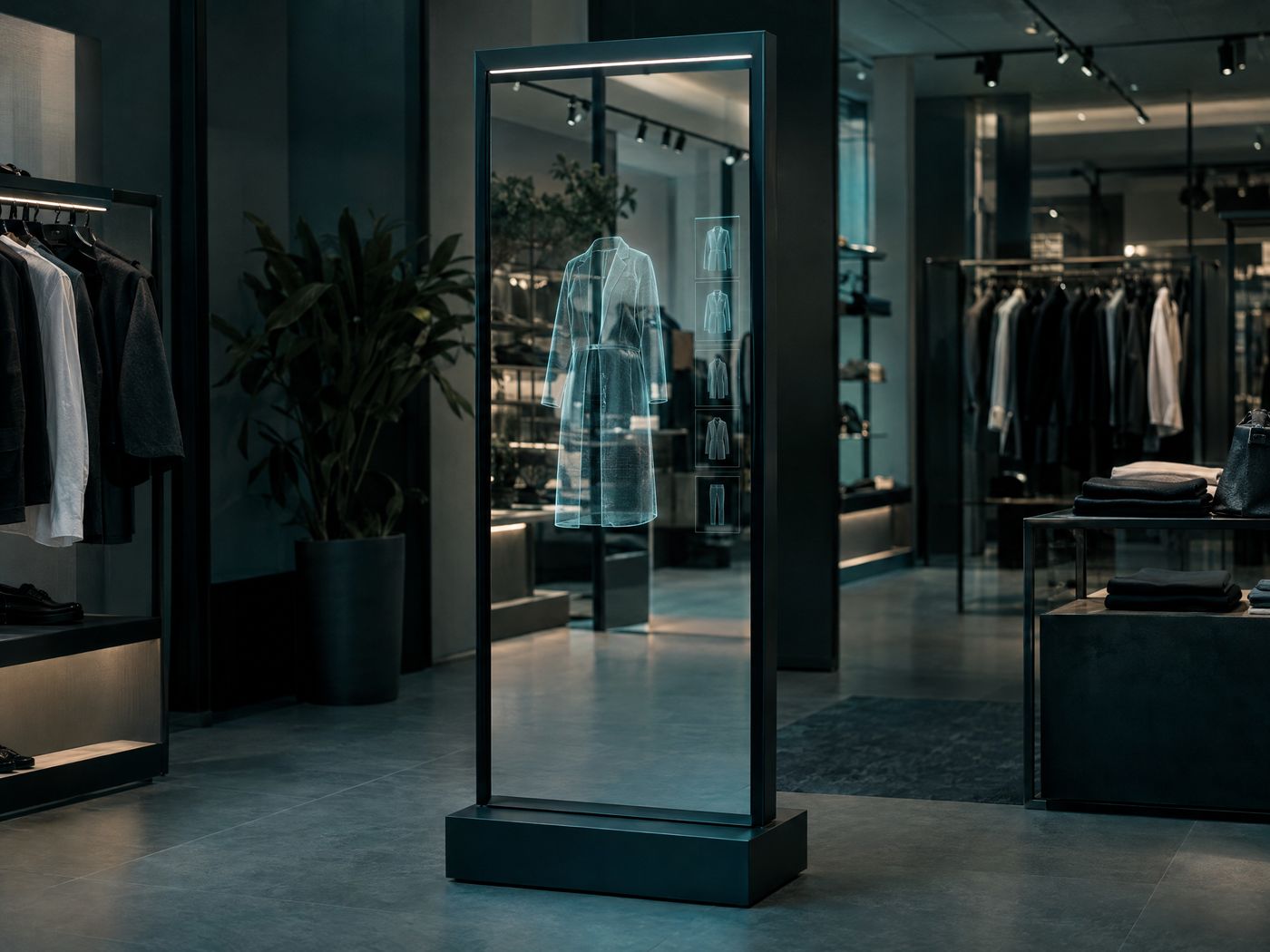
Hardware architecture
Five subsystems, one chassis
- Display and touch — 55-inch 4K commercial LCD at 700 nits behind 3 mm two-way mirror glass, with a 10-point infrared touch frame.
- Compute — Intel Core i3 mini PC: 16 GB memory, 512 GB NVMe, dual 4K output, Wi-Fi 6 and wired Ethernet.
- Sensing — Kinect-class time-of-flight depth camera in the top bezel for skeleton, hand and zone tracking from 0.5 to 4.5 m.
- Enclosure — 2.0 mm laser-cut, powder-coated steel frame at 1.9 m, weighted plinth, levelling feet and a lockable service door.
- Service — front-access panel, tool-less module swap and a 48-hour burn-in on every unit before shipping.
Sensor module: time-of-flight successor to the Azure Kinect class device, with legacy depth sensors supported for pilot kiosks.
Platform
Software is done and deployed
The platform is installed, versioned and remotely managed today. Our work on it now is industrialisation of the hardware around it.
Try-on renderer
3D garment warp with body-shape fitting, occlusion and cloth shading, running at 4K and 60 fps on the kiosk's own processor.
Gesture SDK
Skeleton and hand tracking with pinch-scale, swipe and dwell-to-select mappings; one SDK shipped on every kiosk.
Catalogue service
SKUs, sizes and colourways synchronised from the retailer's product information or ERP system, with an offline cache so a kiosk keeps selling without network.
Kiosk OS & fleet manager
Signed remote updates, device health telemetry and scheduled reboots across an entire retail estate.
Analytics
Try-on funnel through to conversion, size-demand reports and garment heatmaps exported into the retailer's existing business-intelligence stack.
Provisioning
Imaging, licence provisioning, sensor alignment and telemetry enrolment are line stations, not field tasks.
Manufacturing plan
100 kiosks a month on two assembly cells
Six technicians, five stations, a 100-minute takt per unit — 4.8 units a day over 21 working days. A second shift takes capacity to 180 units a month without new floor space.
Frame & glass
Jig-aligned steel weld, mirror bonding to the panel, seal cure before the frame leaves the station.
Display & touch
Panel mount, infrared frame calibration and a dead-zone test across the full glass surface.
Compute & sensing
PC imaging, sensor alignment, firmware and licence provisioning recorded against the asset tag.
Test & burn-in
48-hour soak, gesture calibration and QA sign-off with a photo record retained for the unit.
Station 5 — pack & ship
Foam-lined crate, pallet, asset tag and telemetry enrolment, so a kiosk appears in the fleet manager the moment it is powered on in store.
48h
Burn-in per unit
100
Minutes takt time
180
Kiosks per month on a second shift
600m²
Assembly and test footprint
| Display | 55-inch 4K commercial LCD, 700 nits, optically bonded to 3 mm two-way mirror glass |
|---|---|
| Touch | 10-point infrared frame over USB; retained for accessibility and admin |
| Compute | Intel Core i3-1315U mini PC, 16 GB DDR4, 512 GB NVMe, dual 4K output |
| Sensing | Kinect-class time-of-flight depth camera, skeleton/hand/zone tracking |
| Gesture envelope | 0.5–4.5 m, 30 fps tracking, sub-100 ms response |
| Lighting | CCT-tunable LED strip with diffuser on a 24 V driver |
| Audio | Two 10 W speakers with amplifier |
| Power & thermal | 400 W supply, surge protection, two low-noise fans |
| Chassis | 2.0 mm laser-cut powder-coated steel, 1.9 m height, weighted plinth, levelling feet |
| Access | Front-access panel, tool-less module swap, lockable service door |
| Connectivity | Wi-Fi 6 and Ethernet; fleet-managed with signed remote updates |
| Validation | 48-hour burn-in, dead-zone test, gesture calibration, QA photo record |
Deployment model
- Site survey: power, network, daylight angle against mirror glass, footfall and queue geometry.
- Delivery on pallet with quick-start kit; two-person installation into a store fitting-room zone.
- Telemetry enrolment at power-on, so the kiosk reports health before the first shopper uses it.
- Catalogue sync from the retailer's system, with an offline cache for network resilience.
- Scheduled reboots, signed updates and device health monitored across the estate.
Flagship stores
Try-on without garment limits; queue data captured for assortment planning.
Malls & department stores
Shared installation footprint, per-brand catalogue sessions.
Online pickup
Reduce returns at the point where the shopper is already standing in the store.
Fit labs
Size-demand reports fed back into grading and buying decisions.
Put a kiosk in your next pilot store
Tell us the fitting-room geometry and the catalogue source. We will return an installation plan, a measurement baseline and a deployment timeline.